The Familiar Strangers
It was warm and heavy, the kind of heat that clings to the skin after rain. The storm had just passed, but the sky remained sulky, and the forecast for tomorrow promised nothing but the same. She had long grown used to the island’s climate and its quiet, stubborn ways—so much so that when she finally returned to her birthplace, the air there felt almost foreign. Four months weren’t enough to adjust. Twelve years had passed since she’d last set foot there, and when the trip finally happened, it felt like anything but a homecoming. Nothing felt right. She expected change, of course. Everything transforms and develops, but not like this. Not into strangers. Not in absence.
The country she’d once called hers hadn’t turned its back —just shifted, quietly, like something that had learned to live without her. The city still stood, but the feeling was gone. Familiar streets kept their shape, but not their story. She walked among people and felt alone. So much alone… Painfully alone. Everything there was stripped of meaning, looked different, and sounded off. Even that cousin, one of the few relatives who acted like family, seemed oddly distant. She hadn’t invited her out of warmth, but rather out of some half-hearted need to complain about life itself. They had been inseparable once, two little girls wrapped in long summers, and shared secrets at their grandparents’ house. That closeness held until the older one turned thirteen. After that, everything shifted. The younger one felt the fracture deeply, although she couldn’t name it at the time; it simply resonated —a strange mix between an ache and silence, where there had once been laughter and cheeky mischief.
At eight, she couldn’t understand why her cousin suddenly needed teenagers around, why games turned into sighs, and slammed doors. She only knew she’d been left behind. So she turned inward, toward books, discipline, and friends who already knew what they wanted from the world…
Time slipped by, unobtrusive and quiet. The two had long since taken separate paths in life, and though they still saw each other at weddings, christenings, and the occasional holiday gatherings around New Year’s, the bond they once shared no longer existed, at least not in the shape Maraya remembered from childhood. Somewhere deep inside her, almost beyond reach, she clung—instinctively, irrationally—to the memory of kinship and friendship, to that stubborn loyalty that hadn’t faltered when Diona drifted away, or when she went through a string of abortions brought on by impulsive choices, or when people around her whispered, pointed, critisised her for the way she latched on to men of influence, always for her gain.
And still, it was Maraya who stood by her, who defended her to the end—against judgment, against reason, even against herself—while Diona used that loyalty like a step, climbing higher each time, reshaping her image through marriages that promised more money, more status, more recognition, and shine. In the circles she moved through, people shared her morality: obsessed with fame and the spotlight, rootless by will, not by fate. That was a sad but convenient reality—one that required nothing more than the right bed, at the right moment, with the right man, to gain access to the next riyng of power. That was Diona’s strategy. And she had climbed it well. She had made her way into the world of the wealthy and the famous. At every opportunity, trying to draw Maraya in, tempting her with stories and insisting that she could help “strategically organize her life better” and through the “right” men.
But Maraya had been raised differently. She was a good girl, shaped by effort and discipline, taught to earn what she had and never to trust what came too easily—because anything gained without cost could be taken away with a single gesture, collapsed like a house of cards. She was taught to use her mind, to be deliberate in her choices. Her intellect was quick, sharpened by instinct, gifted by nature. The only thing she struggled to overcome was the mule-like stubbornness that sometimes betrayed her, leading into awkward or painful situations. She blamed it, in part, for the resilience in her character, for the way her behavior had formed a reputation: difficult, reserved, even cold and complicated to manage. She was smart, yes, but unpredictable when provoked, and she held nothing back when she broke—no words, no mercy. And yet often, she regretted it.
Diona, on the other hand, was colder, sharper, and more calculating. Ruthless, if the goal was worth it. Perhaps that hard edge ran in their blood. Maybe, if the two were combined, they would make the perfect creature for society’s gaze: brilliant, dangerous, irresistible.
After a string of marriages and divorces, Diona had secured herself a comfortable income, enough to choose the men she wanted, though love remained a stranger. Each last one had been the best so far; each next, appraised first and foremost by his social status.
Maraya never chased anyone, especially men, or fame. In the early years of her career, she worked as a research associate at the archaeological museum in her hometown, Varna. She had just completed a master’s degree in public communications and occasionally published short articles on archaeological discoveries around the world. With time, she began to travel more and used the rise of online platforms to share brief video reports of her explorations and findings. Recognition followed, quietly at first, then more broadly. Sponsors came. So did the attention. Her willingness to voice controversial theories—especially those orbiting the forbidden zones of power and history—began to trouble her employers. Eventually, the museum labeled her “unfit” for its image and terminated her contract, citing reputational harm. She wasn’t surprised. Not saddened either. If anything, she felt lighter—a quiet relief at walking away from something that no longer felt like hers. Now she could travel freely, visiting ancient places by choice or feeling, no longer accountable to institutions or expectations.
There was a quiet confidence in the way she spoke, a natural charisma that didn’t clamor for attention but held it. A kind of truth that disarmed rather than disturbed. More and more people began to notice her.
With the well-placed attention came sponsorships, collaborations, and recognition.. Her voice, presence, and rhythm began to matter in certain circles.
She still called both countries home, even if something in her never stopped aching for Bulgaria. It was more than nostalgia—it was a quiet grief over how many of the young people continued to flee, pushed out not by war or famine but by the slow erosion of hope under the same stale corruption and recycled politicians.
She had no respect for the so-called “new elite” — flashy minds dressed in connections and cash, wealth rooted in questionable origins. Back home, they were presented as role models, the pinnacle of success. She didn’t believe in any of it—the image, the influence, the noise. And yet, bitterly, her cousin was one of them. Yet, the worst irony remained: standing right at the top of that chain.
For Diona, it had become something of an obsession, a hunger disguised as sophistication—a desperate effort to outrun her own beginnings.
But fate, as always, had its timing. She met a wealthy American with properties scattered across the world’s most coveted destinations. Diona had targeted him early and never lost sight—not until his name was stitched into her passport and daily life. It was her cleanest kill.
Designer clothes, marble interiors, perfume priced like antiques, and a calendar packed with treatments meant to delay time—all of it became part of her new normal. Gadgets and sleek tech completed the daily picture. And still—no friends. Just followers. Admirers. Most of whom had begun, without shame, to envy her out loud.
Even at the height of her triumph — with his name on her passport, the keys to his homes in her bag, and closets stuffed with curated luxury—she was alone. Not the poetic kind of alone, but the hollow, silken silence that settles in marble kitchens and king-sized beds. Her husband was never around, most of the time excusing himself with the pathetic phrase: “It’s only business, darling.” And she wasn’t naive—women like her weren’t meant to believe in fidelity.
Divorce was out of the question; it would damage both of their reputations. For fame and position, they were willing to sacrifice the last honest parts of themselves. So he stayed. And she stayed amused, at first. But boredom is a slow poison in life, this manicured. And then the sex became scripted—the shopping, numbing…. the charity galas, nothing but tax strategies in sequins.
The wealth never satisfied—only softened the edges of emptiness, made it easier to ignore but not to erase. No love, only lighting. No intimacy, only envy. Under the weight of all that glitter, she was sinking—tucked inside a golden cage, chosen, decorated, and furnished entirely by her own hand. And though she couldn’t yet name what was wrong, something primal stirred in her—a quiet instinct, the kind animals trust without question—that warned her she was vanishing, slowly, imperceptibly, and that something had to shift before it was too late. Suddenly, just like that, out of nowhere, she made the most significant decision of her life. She started reading. At first, it was just fashion magazines — the glossy kind, full of empty sparkle. Then came the romance novels — predictable, mildly satisfying, and easy to absorb.
But life, in its usual irony, had other plans.
She came across a book, likely forgotten by her cousin, tucked between old magazines on the terrace. Something about it — the battered spine, maybe, or the cryptic title — caught her attention. It was a conspiracy book by someone named David Icke. The name meant nothing to her. But the man looked decent enough in the author photo, and the fact that it was a second edition had to mean he was popular — and likely, she reasoned, financially successful.
She opened and started reading it.
The ideas struck her as insane. The theories felt ridiculous, detached from reality. But doing nothing — truly nothing—was worse. And so she kept reading.
What began as a curiosity turned into a need, and the need grew into an obsession. The more she read, the deeper she fell—not into faith, but into layers of history, theology, and art that had once seemed distant and irrelevant. She didn’t stop at David Icke’s books; she chased every reference, followed every thread. One book led to another, and before long, she found herself wandering through the corridors of lost civilizations and shadowed power structures, through forgotten temples and academic debates, through secrets hidden in plain sight.
But her husband hadn’t married a woman who asked too many questions. He hadn’t signed up for a mind that wandered far beyond cocktail parties and curated smiles. What he had wanted was a trophy—beautiful, composed, and politically harmless. What he got was someone dangerous: an Eastern European woman with the face of an Italian and the hunger of a scholar, whose ideas no longer fit in the quiet, golden box he’d placed her in.
And so he panicked.
Not because he stopped loving her—if he ever did—but because his associates began asking questions. Whispers turned into unease, unease into ridicule. It was no longer about her theories on reptilian elites and underground cities; it was about his credibility, his image, the quiet snickers behind his back that grew louder with every gala they attended together. This wasn’t about love. This was about reputation. And for the sake of that, he agreed to divorce her, knowing full well what it would cost. Nearly twenty million in assets gone in the time it takes to sign a name on paper—but that was the price of silence. Of erasure. Of restoring his standing in a world where men like him couldn’t afford wives like her.
After finalizing her divorce, Diona called Maraya with a proposition: she would cover all travel needs if she agreed to meet and plan a joint journey to some of the world’s ancient and iconic sites. For Maraya, it meant fresh material for her YouTube channel; for Diona, it was a way to mark her newly claimed freedom in style. It didn’t take much to convince Maraya. A week later, they were to meet in Dubai, sketch out the outline of their trip, and head off toward the first of many destinations.
Seven days weren’t much, but it wasn’t nothing either. Maraya used the time wisely, sorting out documents, tidying up personal matters, and even briefing her lawyers as a precaution — a practice she followed before every long trip, and this time was no exception. She remained loyal to her system, without exception. The day before her flight, she even had time for a bit of shopping and leisure, knowing full well that where Diona was involved, there would eventually be men, glitter, and extravagant gatherings. Maraya didn’t fight it — didn’t try to change what wasn’t hers to shape. That, in her eyes, was the mistake most people made. She, on the other hand, had her principles forged through years of quiet observation and sharpened into something she could trust — and she followed them without needing applause.
Diona, true to herself, managed to squeeze in every last cosmetic tweak that could be scheduled on short notice. She stocked up on trendy, mostly useless travel gear and accessories, only to realize she’d need a personal sherpa to haul it all, which, of course, wasn’t happening. The plan was to move quickly, lightly, and inconspicuously, which limited their luggage to one medium-sized suitcase and a large, practical backpack.
Despite her flair for extravagance, Diona handled the limitations with the poise of someone pretending it was her idea all along, though flying without fake lashes or a full-face emergency kit came dangerously close to triggering a crisis of identity. Luckily, the breast implants and lip fillers were permanent investments — unapologetically hers, borderless, duty-free, and emotionally non-refundable. When it came to clothes, she didn’t trouble herself too much with planning — airports had stores, cities had boutiques, and if an unexpected occasion required a more formal appearance, she could always improvise; it wasn’t as if she’d be attending an opera, and even if such a thing she would act acording to the situation. She had long mastered the art of shifting her opinions, desires, and demeanor depending on the people around her — an instinct as natural to her as reaching for her lipstick — but with Maraya, that reflex didn’t activate. Something about her presence reached past the surface and pulled Diona back to a version of herself she barely remembered — one that didn’t rely on charm or masks. With Maraya, she felt — not always, and not entirely, but enough — as though she could let go of the polish and the performance, and for a fleeting moment, inhabit something raw and almost honest.
There was something about Maraya—quiet, measured, and terrifyingly lucid—that disarmed the usual defenses. With her, posturing felt absurd, theatrics fell flat, and even self-deception had nowhere to hide. She didn’t demand truth; she made it the only thing that made sense. She had that rare gift of making people think. And somehow, in her presence, Diona—so used to commanding rooms with charm and control—felt stripped down to something raw, almost noble. It disturbed her composure, but strangely, she found herself liking it even more.
As for combat skills, Maraya didn’t have many — nothing formal, nothing trained. But Diona had seen something else once. A flicker of raw fury. It had happened only once, back when they were teenagers and Diona had dragged her younger cousin into a nightclub as a cover story for their parents. The night had turned sour fast. No fault of her own, Maraya had found herself at the heart of a messy brawl between girls, and when there was no one else to protect them, she fought. Not out of bravado, not because she enjoyed it, but because someone dared to lay a hand on her. That was what provoked her.

Later, she admitted she remembered very little — not the noise, not the pain, only the way her body moved without hesitation. The pain came later, when they had to pop her joints back in place. That, she felt. Diona had gotten away with a black eye. Maraya, with a lesson: rage and adrenaline didn’t make her stronger. They made her reckless. And recklessness, she understood, had a cost. So she learned to keep them caged — not because she couldn’t burn, but because she’d already seen what happened when she did. On that night, they told their parents they’d been in a car accident — a hit-and-run, to be precise. And in those years, no surveillance cameras were lining the streets, no digital breadcrumbs to follow. Nothing could be proven. Nothing needed to be. The lie held just enough truth to settle into silence.
***
Diona, unusually quiet, was lost in her thoughts — a state that didn’t visit her often — when her phone rang, snapping her back to the present. Maraya’s name lit up the screen.
“Well, cousin? Ready yet? Packed your heels and your gowns?” came the teasing voice on the other end.
“Oh, come on! Being fashionable isn’t a crime! But this time I’m only taking the essentials… plus Grandma’s gold medallion. You bring yours too! I’d love to see you wearing it.”
In Bulgaria, it was tradition to mark the end of compulsory education with a night of music, dancing, and elegance — a graduation ball where young men and women stepped into their finest clothes and, for one night, stood on the edge of childhood, peering into the world of adults. On that day, close friends and family would come together to offer something that might last — often a piece of jewelry, chosen not for fashion but for memory, meant to stay with them as they moved forward into whatever came next.
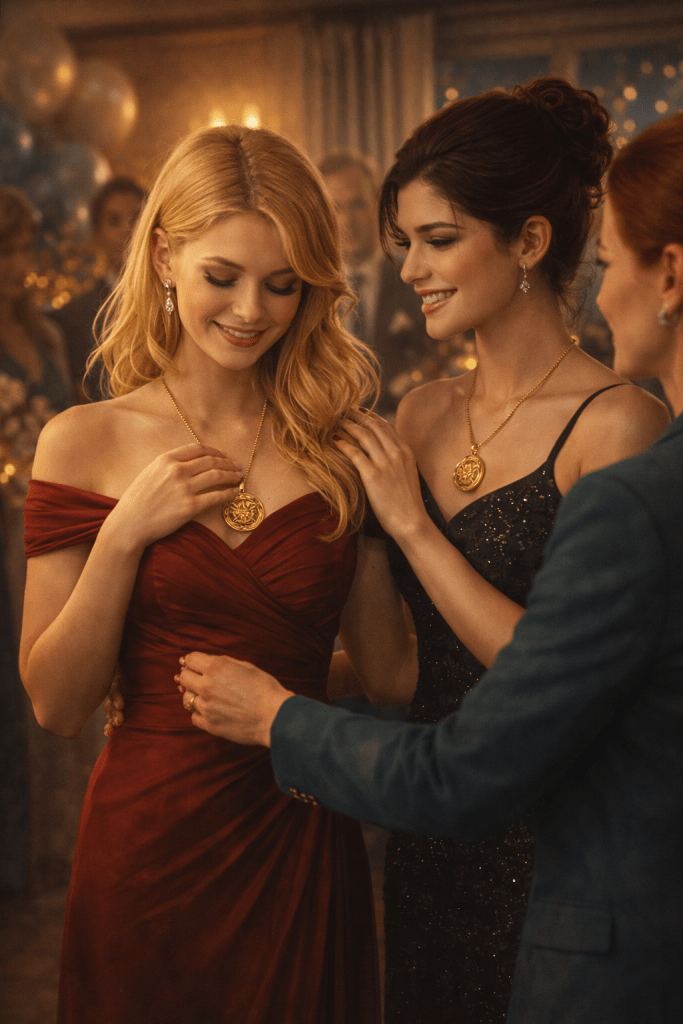
On such nights, four years apart, their grandmother had placed identical medallions into their hands — heavy, old-fashioned, unmistakably Bulgarian — not beautiful by modern standards, perhaps, but rich in weight and meaning. They didn’t wear them often, but they never left them behind. These weren’t just ornaments tucked away in a box; they were a thread, subtle and intense, tying them to the women who had walked before them, and maybe — just maybe — to the women they were still growing into.
Maraya agreed, and they set the place, the day, and the exact hour. Diona, predictably, insisted on choosing the starting point — not out of taste, but out of sheer pretentious flair. And since she was covering the costs this time, there was little room for negotiation.
She picked one of the most extravagant hotels in Dubai — a favorite among Bulgaria’s self-proclaimed elite — the Burj Al Arab Jumeirah, or as it was commonly referred to back home, “The Arab Tower.” With its 56 floors and wind-swollen sail design, the hotel was more spectacle than shelter. Built on an artificial island 280 meters off the coast and tethered to the mainland by a private causeway, the structure had devoured two billion dollars — and yet somehow, it had risen in just three years. They planned to spend a short while there, not just indulging in luxury, but finalizing the details of their route and plotting the journey that lay ahead.
The flight from New Zealand to Dubai — long, silent, and suspended between time zones- gave Maraya just enough hours to begin shaping the arc of what lay ahead. She had no interest in the sanitized marvels stamped onto every tourist brochure. What drew her were the remnants that still held their breath — ruins half-buried not just in sand or jungle, but in doubt—places whose stories had not yet been declawed by consensus.
Her list included sites like the Udayagiri Caves, the Varaha Pillar, the Obelisk of Axum, and the ruins scattered across Ethiopia — structures far too sophisticated for the eras to which archaeology politely assigned them. There were other intriguing places across Asia, equally deserving of a detour. Judging by the pace she envisioned, six months would barely cover the essentials.
If nothing else, Maraya made an excellent guide — and thankfully, Diona seemed ready to spend, this time on something more enduring than implants or branded trash.
Her thoughts were interrupted by the motion of a young driver waving a sign — her name, written in Bulgarian, wobbling slightly under the weight of the cardboard and the heat. He kept adjusting it with both hands, a gesture that finally caught her attention. Of course, Diona had arranged this. And knowing her, this was only the beginning of what she probably considered a dazzling welcome.
The young man was dressed in the sort of elegant suit chauffeurs are meant to wear, holding his cap under one arm until, with almost ceremonial precision, he placed it on his head and reached for Maraya’s single suitcase. He was well-built, and the suit fit as if it were tailored, which made perfect sense. If Diona had to choose between two equally qualified candidates, she’d pick the better-looking one every time.
What was more surprising was that this particular employee seemed to have a decent grasp of etiquette — and possibly even of the local customs — despite being on Diona’s payroll. He escorted her into a glossy Rolls-Royce, the latest model owned by the hotel she’d been booked into: the Burj Al Arab, shaped like a sail, planted in the water on its private island. The most expensive, most ostentatious place Diona could’ve chosen. Naturally.
