Chapter 1
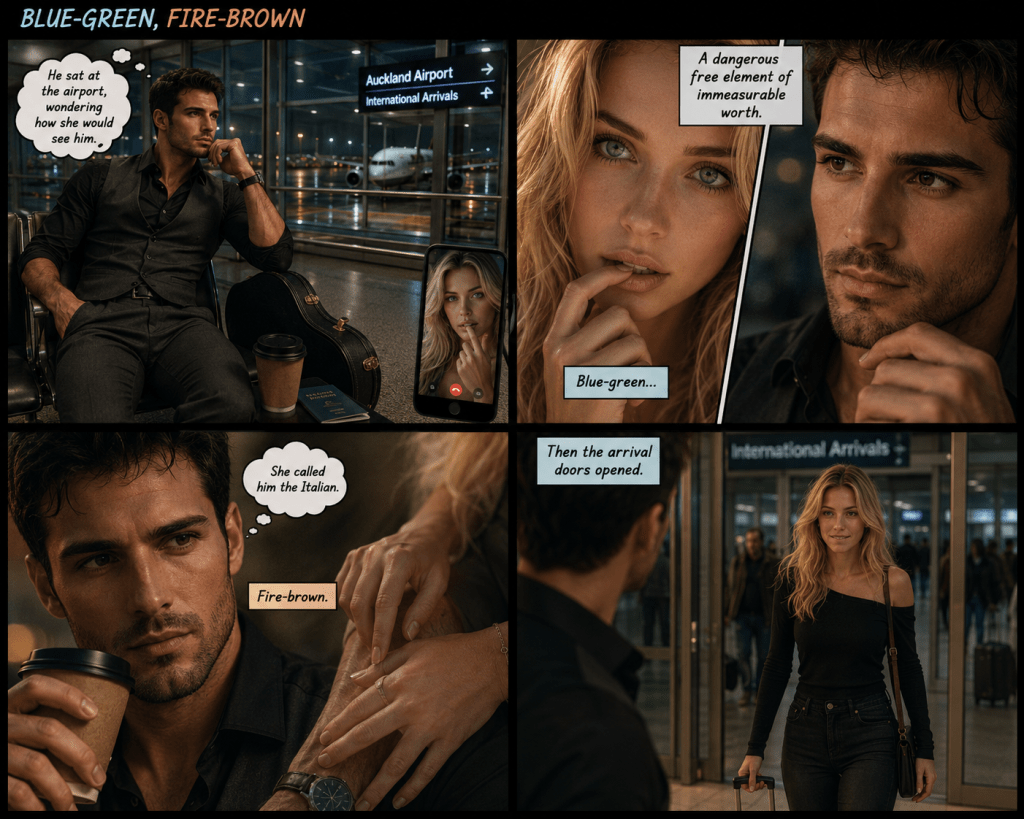
He sat at the airport, wondering how she would see him. He already knew her face from their online calls — the white, almost translucent skin, a sharp contrast to his own sun-warmed tone; those blue-green, catlike eyes that seemed to look right through the world; the loose, golden strands framing a face that was all symmetry and quiet challenge. He even liked her lips — the way she’d lick them when she was excited, unaware of what that small, innocent gesture did to a man’s imagination.
She fascinated him — unpredictable, magnetic, impossible to categorize. “A dangerous free element of immeasurable worth,” he’d once said, half-mocking himself for the poetry. But he meant it. He knew she would be his — not by force, but by inevitability. There was something in the pull between them that made resistance feel pointless. He had been her first spark — the first man who truly touched her. Tall, broad-shouldered, with that quiet confidence that needed no words. His skin had that muted, sun-touched tone — not dark, but warm, somewhere between ivory and bronze — the kind of skin that remembered light even in shade. She used to watch the way his shirt stretched across his chest when he moved, the subtle play of muscle beneath the fabric. She called him the Italian — half in jest, half in worship. He played the guitar the way some men undress a woman: slow, deliberate, knowing exactly what each note did to her. His hands were strong, the veins running along them like fine blue cords — she had traced them once, curious how something so hard could feel so tender.
But it wasn’t his body that undid her. It was his gaze. Those dark, molten eyes — brown so deep they were almost black — held a heat that stripped her bare without ever touching her. When he looked at her, she forgot even how to speak, and when he smiled, the air changed.
He had never told her he loved her, not until that night. And that night, the words came rough, broken by breath — “I love you.”. She froze at first, heart caught in her throat, but then she whispered them back, unsure whether it was love she felt, or something even more dangerous.
Later, with time and countless summer nights steeped in tenderness, she understood. It was love — first, unfiltered, fierce, and real. Her heart was his. Her body, her mind, too.
For a while, it had been a fairytale, and she — the princess who finally believed in magic.
Everything felt surreal, almost magical, until one September night, just before her birthday, when his parents announced they were leaving for New Zealand—his father’s final mission before retirement. That was the night her world came crashing down. The sky split without mercy, collapsing over her, and the girl she had been was torn away in the wreckage. What remained was a hollow silence and a vow: never again! Never to love, because love was pain, and the heart carried the deepest wound of all. She swore she would take any man, but never surrender her heart. That was not a hard promise to keep because she possessed the quiet gift of listening, the sharpness of an analyst, and the instinctive ability to slip into other people’s minds. She could touch their thoughts, even guide them, yet kept her own heart locked away.
That is how she spent her university years, balancing study and work, and occasionally allowing herself some fun, as her youth required, until the day after her graduation. That day, she never forgot, because her father, without any warning or even a hint, pressed a plane ticket into her hand with the destination to New Zealand. At first, she couldn’t believe what had happened, but when her focus returned, she caught herself trembling at the weight of the chance life—and her father—had offered. For a long moment, she stood speechless, lips parted, because she understood: he was sending her to him. No promises. No plans. Only the kindness of old friends who would shelter her until she could stand on her own two feet.
Alexander wanted more for Ale. His decades of service as a high-ranking officer had taught him one truth beyond all illusions: there is no painless transition, even when politicians told the Bulgarian people otherwise; he knew better. Change often arrives when the great and dear price is paid; furthermore, this one would be merciless. And like countless other parents, he searched for a way out. And like them, he found it—for his children, just as more than a million Bulgarian families were forced to do.
All of this Danielle felt as well, and that’s why he was actually happy that his childhood friend was sent back to him, even with a higher expectation of protecting her. He knew he had gained the trust and respect of her father. Words were not needed; simply the choice of a parent who naturally wants the best for their child spoke for itself.
Alone in the terminal, he felt time stand still — calm, precise, motionless. A strange current ran through him — part anticipation, part unease. He caught himself thinking of her face again, wondering how she would read him in person, whether his voice would sound the same, whether the spark that lived so easily between them through screens would survive the distance of the real meeting after so many years. Excitement tangled with doubt; desire with restraint. He wanted to see her, to know her scent, to find out if the smile he knew so well would have the same effect in real life — that same disarming pull that lingered long after she was gone from the screen.
The young man wasn’t worried about her visa; his and her fathers stood behind it — bold men, old-school soldiers who tested everything to the limit and left nothing to chance.
He could still picture them: the two generals, side by side, hands marked by smoke and oil, eyes weathered by the kind of silence only war teaches. They had been more than allies — they were brothers in action, back to back when the air turned lethal, dragging each other out of fire and shadow. Their families had grown close through those years of danger and secrecy, shaped by the same absences and unspoken loyalties. Bonds like that reach deeper than blood — deeper than the ties of siblings born of the same parents.
And Ale… she was her parents’ daughter in every way. He remembered the stories she had told him — how she had inherited her gift for languages from her mother, a translator of the highest rank, who had passed it from one ministry to another like a secret too valuable to put on paper. In her private archives and in her memory, she carried truths for which people had been willing to pay fortunes. And when money failed, threats followed. Their home in Bulgaria had been searched twice. Once, set on fire. The folder was never found. Over time, it had all been buried — forgotten, or at least pretended to be. Only one trace remained: Ale’s necklace. A delicate locket carrying the digits of a code to a Swiss vault. She had no idea what she wore around her neck. She’d only been told this — inside it was a key. A key to an alternate way of thinking. Of surviving. Something the world hadn’t yet learned to value.
The hardships in little Bulgaria and the rough, early post-communist years had disciplined her. She knew how to survive. When to take. When to give. Her curiosity hadn’t flinched even when a university friend — an up-and-coming journalist — was disfigured with sulfuric acid, a brutal warning for the truths she had dared to publish. Ale had worked for half a year, giving away every paycheck and every tip she earned at the bistro — for the surgeries, the therapies, her friend’s return to life. He could hear her voice even now, calm and detached as she’d told him that story — but he’d felt what lay underneath it: the weight of memory, the quiet strength that came from having walked through fire and come out unburned.
Then, the sound he’d been waiting for — the soft mechanical chime of the arrival doors.
He rose before he even realized he had moved. The crowd shifted, spilled forward — and Ale appeared. She walked toward him with unstudied ease, drawing him toward the chairs at the airport café, the very place where he had been waiting minutes before. Her smile broke wide and bright, her body moving with a grounded, graceful confidence. Instinctively, she caught her lower lip between her teeth, then moistened it. The Italian saw—and understood. The feeling between them was not only alive but elevated when they saw each other in person after so many years. His body answered hers, subtle, sure. He returned her smile, casual yet deliberate, echoing her unspoken tease, and as they sat, he took her hand. When her fingers brushed his, he pressed twice—softly, almost imperceptibly. The signal was clear—and received. Their old trick, a silent code from the past. A warning. Something was wrong. Or someone had appeared—someone like Colonel Igor Ugrachenko. This man had been their strictest instructor — their shadow, their ghost. Session after session, he shaped them with a precision that felt almost cruel, stripping away one layer to refine another. He trained them not by society’s rules, but by doctrines written centuries earlier — philosophies long buried, yet still alive in secret circles that officially do not exist. His tasks were never about obedience; they were about transformation. Each assignment stripped them further of certainty, forcing them to unlearn before they could understand. He taught them to read patterns in chaos, to listen to silence until it spoke, to feel the pulse of intention behind every gesture. What looked like discipline was, in truth, a dismantling of the self — a descent meant to rebuild something more substantial, purer, more deliberate. He gave them no comfort, only mirrors — and in those mirrors, they learned what it meant to stand alone.
He believed humanity had to be trained—carefully and patiently—so that one day it could stand face-to-face with advanced civilizations. Such meetings had already happened, though history disguised them as legend. Continents disappeared. Civilizations collapsed. Each time, humankind mistook contact for command —a divine order from higher beings —and bent its will in surrender. That pattern had to end. Humanity must stand upright, with the bearing of equals, ready not for worship but for dialogue—for genuine communication.
The last significant failure, he warned, had been the Nazi occult society Thule. Knowledge was given, but twisted. The result was catastrophic: war bent the trajectory of human evolution, scorched its future. At the dawn of a new millennium, it had to be corrected—by a generation forged differently, raised to think, to perceive, to teach.
Their lessons rarely looked like lessons. They came wrapped in conversation — a question over coffee, a debate stretched deep into the night, a passing remark that lingered long after the speaker was gone. Sometimes, the instructors were visiting professors from renowned European and Eastern universities. At other times, they found themselves sitting across from Tibetan lamas or Indian yogis, whose silence carried more weight than most lectures.
It was only then that the two teenagers began to feel it — that subtle shift in the air, the invisible hand setting them apart. They were not being taught; they were being prepared. Chosen for something unnamed. Privileged, though by whom or for what, they could not yet tell. There were no grades. No failures. Only the quiet hum of cameras, the unblinking lenses that watched and remembered everything — every gesture, every hesitation, every flicker of doubt that crossed a young face learning to hide.
Once, Ale’s curiosity crossed a line. She slipped into hacker mode, prying open the system, nudging past its defenses. What she discovered was a library of files, including analyses, logs, and meticulous notes. They were not simply being taught. They were being studied. Every file recorded the most minor variations—how an iris shifted, how a pupil dilated under the weight of fear, of joy, of desire. She showed it all to Daniele—the Italian. Together, they realized: They were being prepared. For what? When? Why? They could not know.
Then the so-called “democratic years” arrived: the chaos of transition, the noise of slogans, the erosion of order. Everything looked abandoned, forgotten in the midst of the carnival of change. Yet the hours of lectures, the subtle shaping, had already taken root, sinking quietly into their bones. They never saw it, but the cameras continued to roll. Even when the outside world descended into danger—post-communist streets where survival meant cunning and ferocity—the surveillance continued. That very contradiction forced a decision. Those behind the project intervened. That was how Daniele’s father came to be stationed in New Zealand. And it was inevitable that Ale would follow. The truth? The project had never been abandoned. Every move was calculated. Every “accident” was a step in design—a thought smuggled inside a glance, an idea wrapped in chance. It was a game of intellect and control, and of something more—veiled in myth, blurred by mystery. All the while, the cameras continued to roll. She unearthed more folders—each stamped with names of countries, dates, and coded entries. Some stretched back to the Wars. Who was collecting this knowledge, and to what end? She never discovered. One file bore a single title: “New Zealand.” She never opened it. Working incognito—on borrowed logins, fabricated identities—she had only seconds. Seconds to slip inside and vanish again without leaving a trace. Not enough to click. Not enough to save. Only enough to glimpse… and disappear.
